
- Home
- About
- Certification
- Courses
- Continuing Education
- Resources
|
 READY TO START?
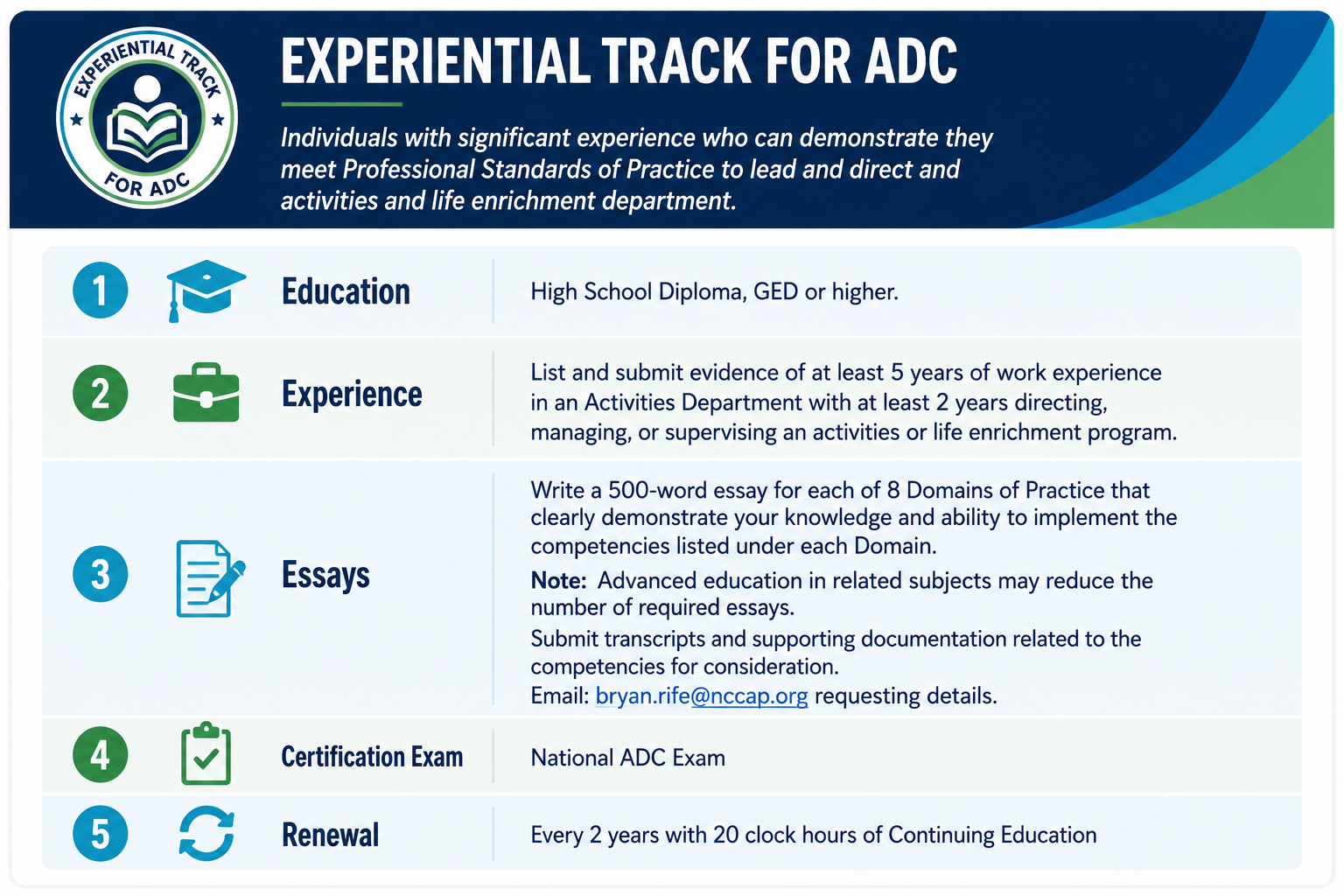
The Experiential Track is intended for individuals who have accrued a minimum of five (5) years of professional experience in the provision of Activity Services, including at least two (2) years in a supervisory capacity directing, managing, or overseeing a program that adheres to the Social Model of Care. For candidates pursuing certification through this pathway, the required educational component is satisfied through the successful completion of a comprehensive essay-based assessment process, in lieu of completing the the Activity Director Certified (ADC) course. All submitted essays and the practicum project are subject to formal review and approval by NCCAP. Candidates must also successfully pass the NCCAP National Certification Examination to be awarded Activity Director Certified certification. The cost of this track is $550 and includes a Resource Book "The Art of Life Enrichment" and National Exam fee (one attempt). Approved candidates will personally write one essay per each Domain of Practice. Each essay will be a minimum of 500 words. These Domains of Practice represent the core areas of professional competency required for Activity Professionals. These domains define the knowledge, skills, and responsibilities necessary to effectively deliver Activity Services in accordance with the Social Model of Care. These domains serve as the foundation for the NCCAP National Certification Examination and guide both the essay and practicum requirements within the Experiential Track. Each essay should be a structured piece of writing that clearly demonstrates your knowledge, experience, and ability to apply concepts to practice. Your essay should be written to show how you apply the Domains of Practice in real-world Activity Services settings. Submissions must demonstrate proper sentence structure, correct grammar, and accurate spelling. Responses should reflect the candidate’s independent thought and professional experience. All work submitted must reflect the applicant’s own knowledge, professional experience, and authentic voice. Experiential essays are intended to demonstrate real-world competency, leadership, and understanding gained through direct practice in the field. Applicants may not use artificial intelligence (AI) tools (such as ChatGPT, QuillBot, or similar platforms) to generate original essay content, fabricate experiences, or substantially rewrite responses. Limited grammar or spelling assistance tools may be used; however, the overall work must remain the applicant’s own. To ensure authenticity, submissions may be reviewed using plagiarism and AI-detection software. Similarity scores above 15% may require revision or additional review. This means:
The submission of AI-generated or AI-assisted work constitutes a violation of NCCAP standards. All essays are evaluated using AI-detection software, and any submission exceeding a 15% AI-generated content threshold will result in denial of certification. The topics for each essay is listed below. The topic is listed formally and is also summed up in plain English – “in other words”. DOMAINS OF PRACTICE 1. Therapeutic Activity Concepts Demonstrates knowledge of the underlying concepts, principles, and professional framework of Activity Services within health care organizations, and possesses the competencies and skills necessary to function effectively within a health care community while successfully implementing facility and departmental goals and objectives. In other words…. Shows a clear understanding of the foundations of the activity profession in health care settings, along with the ability to effectively apply the skills needed to support the community and achieve both facility and departmental goals. 2. Standards, Regulations and Survey Process Projects a professional image by demonstrating a positive attitude, taking pride in one’s work, and adhering to the Standards and Scope of Practice of the activity profession, while continually enhancing skills through ongoing education, participating in professional organizations, and ensuring compliance with all applicable regulations, as well as company policies and procedures. In other words… Maintains a professional attitude, takes pride in their work, follows professional standards, continues to learn and grow, and complies with all regulations, policies, and procedures. 3. Communication Strategies for the Activity Professional Builds strong relationships by communicating effectively through the written word and verbal communication, non verbal communication. Presents ideas clearly to gain support while responding appropriately to others’ feelings and functioning successfully as a manager within the workplace. In other words: Develops positive relationships, communicates clearly, understands others’ concerns, and effectively leads and influences others in the workplace. 4. Aging Through the Life Span Uses knowledge of behavior, personality, and aging to adapt activities and approaches to meet individual needs; supports both individual and group engagement based on the Six Dimensions of Wellness; and respects personal beliefs while providing support for spiritual needs, end-of-life care, and related transitions. In other words: Understands how people change as they age and adjusts activities to meet their individual needs, supports their overall well-being in both group and one-on-one settings, and respects their beliefs while helping them through spiritual needs and end-of-life experiences. 5. Cognitive and Behavioral Health Uses a person-centered approach to care, especially when supporting individuals living with dementia, understands and responds to the impact of family, culture, and environment on a person’s well-being, and promotes effective non-drug interventions that are practical, evidence-based, and tailored to each individual’s needs. In other words: Takes an individualized approach to care, supports people with dementia in a positive and respectful way, considers the influence of family and culture, and uses effective non-medication strategies to meet each person’s needs. 6. Documentation Responsibilities for the Activity Professional Maintains accurate and compliant documentation, using it to guide meaningful activities and care approaches; uses assessments to gather information, build relationships, and collaborate effectively with the interdisciplinary team; and applies this knowledge to support care planning, program development, budgeting, policy development, and ongoing quality improvement. In other words: Keeps clear and accurate records, uses assessments to understand and connect with individuals and the care team, and uses this information to plan programs, support quality care, and meet organizational requirements. 7. Person-Centered Engagement Programs Designs meaningful individual and group activities that promote growth, social connection, comfort, and overall quality of life; adapts programs with creativity and flexibility to meet a wide range of physical, cognitive, and age-related needs; and fosters engagement by creating opportunities for volunteer involvement both within the facility and in the broader community. In other words: Creates engaging activities that help individuals grow, connect with others, and feel comfortable, adjusts programs to fit different abilities and needs, and encourages participation through volunteer and community involvement. 8. Professional Growth and Management of Others Effectively lead staff through planning, hiring, training, supervision, and engagement; ensures the activity program operates smoothly through strong organization, oversight, and quality improvement; and supports ongoing professional growth through continued learning, skill development, and participation in professional opportunities. In other words: Manages personal stress, leads and supports staff effectively, keeps programs organized and running well, and continues to grow professionally through learning and development.
READY TO START?
|